Recently I’ve been developing a curriculum for 0–2 year olds with my colleague and co-author, Aaron Bradbury. Alongside this, I’ve been working with schools, settings and organisations to strengthen interactions with young children, and I’ve also been fortunate to be involved in some really important work around healthy child development. All of this has led me to think deeply about interaction and more specifically, how adults respond when children communicate.
You may be familiar with the work of Colwyn Trevarthen. Trevarthen’s work centres on the importance of attuned adults. Babies and young children need attuned interactions to develop relationships, their desire to communicate and their early learning. Attunement involves the dynamic, moment-by-moment matching of emotional state, timing and intention between two people.
Trevarthen described early interactions as “proto-conversations; turn-taking exchanges using gaze, voice, gesture and movement Babies and young children are not passive, they are biologically prepared to seek connection and they initiate interaction and seek a response. This is what he called primary intersubjectivity; that early, face-to-face, emotionally rich connection between infant and caregiver.
An interaction that made me stop
One of the privileges of my job is that I get to spend time in classrooms. Watching, noticing, thinking alongside leaders and practitioners. Earlier this week I saw an attuned interaction that made my heart sing.
The headteacher and I were visiting a classroom where many of the children were pre-verbal. The adults working there have worked incredibly hard to tune into children’s needs. At the beginning of the academic year, one child often became extremely dysregulated whenever someone left the room. The head explained that the child would actively gather any visiting adults and direct them to sit down together, almost as if they were trying to hold the room together, to keep everyone where they could see them. If an adult left, the distress was immediate and intense.
Initially, the adults responded by physically taking the child and showing them where the people who had left had gone. They then took photographs of those spaces. Over time, this developed into a visual system, the child took the photographs to the space to strengthen the association, and then the teacher made a board with various visuals which allowed staff to show who had left, with a photograph of where they had gone. This was not a quick fix. It was built over time, through careful observation and response.
Fast forward to my visit. While we were in the classroom, an adult needed to leave the room with another child. After they had left, the child in question went straight to the door where the visual board to support them regulate in this scenario is kept. The teacher responded immediately; placing the adult’s photograph and the child’s photograph next to an image of the destination.
“Mr X and X have gone to…”
The child watched. Then moved away. Then repeatedly glanced back at the board. Checking. Holding the idea. Trying to process and manage this idea internally. Even with that additional support and information, the child was not fully settled and this is where the interaction became really powerful and attuned. The child sought out another adult. They reached for the visuals on the adult’s lanyard and found the photograph of the sensory room. They made eye contact and pointed, communicating something very clear:
I need help to regulate.
The adult responded verbally and with Makaton, explaining that the sensory room wasn’t available right now. The child paused. Then searched through the visuals for another strategy to help them regulate .Throughout, there was:
- eye contact
- gesture
- shared attention
- attuned adult response
This is Trevarthen’s work in action.
So where is this child developmentally?
This is an important question that is easily overlooked in the busy classroom. Chronologically, this child is of statutory school age. Developmentally, they are operating within an earlier relational and cognitive stage. For example, the child may not have fully grasped the concept of object permanence yet. At its simplest, object permanence is the understanding that things continue to exist even when they are not visible. This child appears to be developing this understanding, they are beginning to understand that people who leave still exist, people who leave can be represented (through photographs) and that absence can be held in mind briefly. But this understanding is not yet secure.
We can see that because the child needs repeated visual checking, the emotional response (distress) remains, and the strategy put in place to support the concept does not yet fully regulate the feeling. This does not appear to be a lack of understanding, it is an emerging, fragile understanding that still requires external support and this is where the attuned adult is vital.
Attachment and regulation
From an attachment perspective, this is not about labelling the child, but about understanding their experience. What we are seeing is a strong need for proximity and predictability, anxiety when routine is disrupted, active strategies to maintain closeness (gathering adults, directing them to sit) and use of adults as a regulation system. This suggests a child who is still developing confidence in separation and return.
This child is also showing us something incredibly important:
- they are seeking trusted adults
- they are communicating intentionally
- they are beginning to use shared systems (the board, visuals)
- they are co-regulating, not withdrawing
This is not a child who has disengaged. This is a child who is working very hard to stay connected. All of these messages are communicated without words, when attuned adults are able to reflect and interact and all of this takes time.
What the adults have done is remarkable. They have noticed the pattern (distress when people leave), understood the underlying need (uncertainty, loss of connection, attachment), responded with structure and a strategy (visual representations), worked hard to develop the child’s understanding of that structure and stayed emotionally available. And then, crucially, they have given the child tools to think and communicate.
Over time, this has led to a profound shift. The headteacher explained that previously the child would remain dysregulated for long periods. Now they check, they seek support, they communicate their need to regulate, they co – regulate. And that is exactly how development works. Before a child can self- regulate they need an attuned adult to support them to co-regulate.
What struck me about the depth of the attuned interaction that I witnessed was how much knowledge and skill was involved. None of these things happened by chance, and all of them took huge amounts of time and understanding. Often people are dismissive of those who work with young children, but they’re often working with children who aren’t able to express and communicate their most basic needs, and they have to find a way to support them so that they can start to build those all important “serve and return” interactions, whether they are verbal or through other means of communication.
One of the strategies I’ve introduced to support staff, based on Trevarthen’s approach is Notice Understand Respond Adapt.
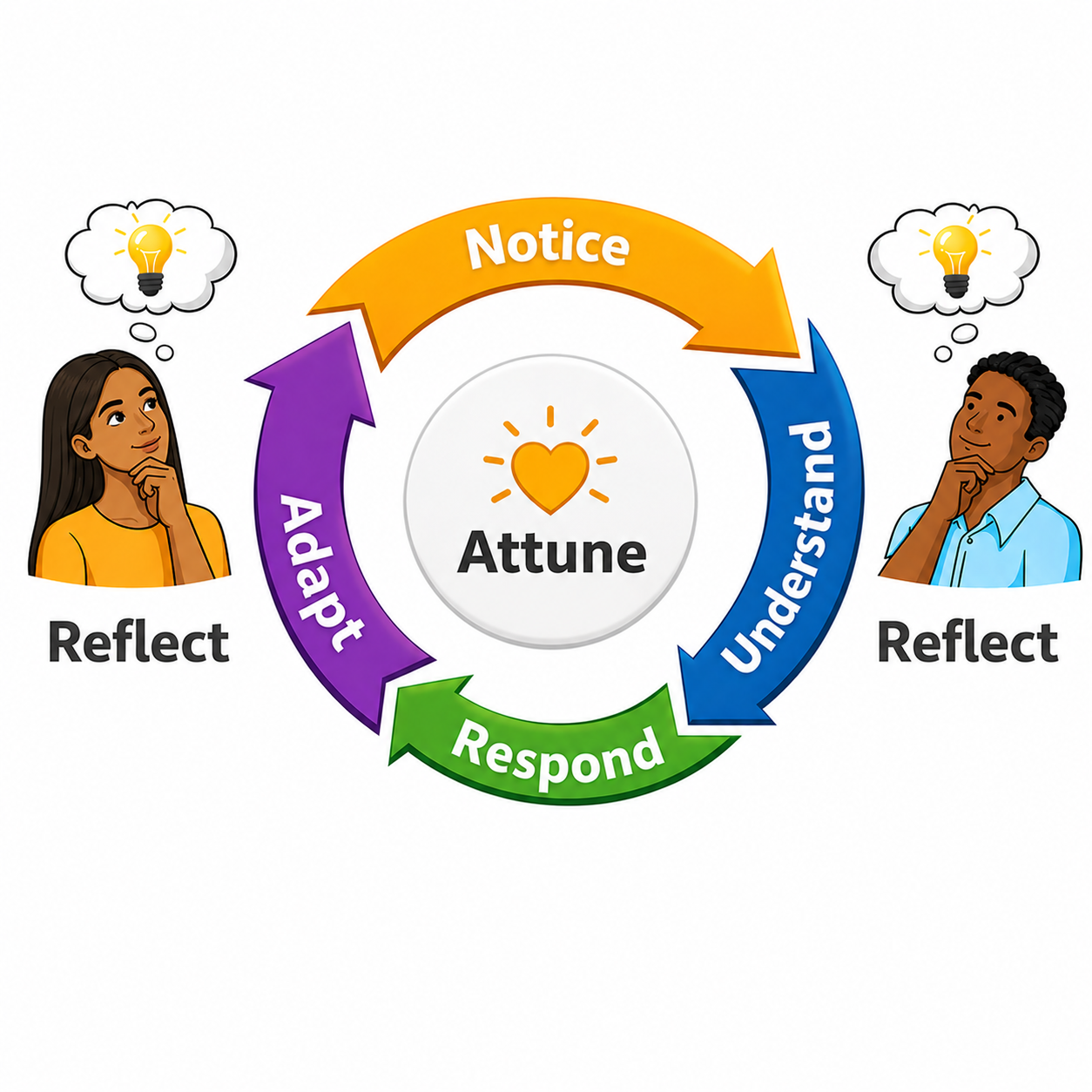
This simple approach supports practitioners to slow down, and really reflect on what the children’s interactions are telling us. The real challenge is to find the time to do this in a busy classroom, with all the demands of the curriculum. Trevarthen’s work is often positioned within infancy. But what I saw in that classroom is a powerful reminder, development does not follow age. It follows experience, interaction and relationship.
This child is engaging in what Trevarthen would recognise as:
- gaze
- gesture
- movement
- shared attention
These are the foundations of communication. These are the foundations of learning. If we try to rush past this stage and prioritise outcomes over interaction we miss the point entirely.
Before handwriting, before phonics, before “learning behaviours”, there must be attunement, shared understanding and relational security. Because it is through these that children begin to understand that people come back, that feelings can be managed and that communication works and that their important adults can be trusted to help them feel safe and secure. From there everything else becomes possible.

Leave a Reply