The recent update of the UK Chief Medical Officers’ physical activity guidance has brought an important message back into focus for those of us working in early childhood:
Young children need to move—and they need to move far more than many of our early years environments currently allow.
For children aged one to four, the recommendation is at least 180 minutes—three hours—of physical activity at any intensity, spread throughout the day. For children aged three to four, these 180 minutes should include at least 60 minutes of moderate-to-vigorous physical activity. Once children turn five, the guidance changes to an average of at least 60 minutes of moderate-to-vigorous activity each day across the week.
For many children in our Reception classes, the expectation of 180 minutes per day applies for much of the year. Most children start school at the age of four, and some will have celebrated their fourth birthday only days before they arrive, some will be four until they move into year 1.
These are daily totals, shared across home, the setting and the wider life of the child. However, children attending an early years setting or Reception class may spend most of their waking day with us. As Claire McCarthy, MD, points out:
“As devices become more pervasive, and as many children become more scheduled with lessons and organized activities, making time for device-free play can become forgotten” (McCarthy, 2023).
We cannot presume that all children have safe spaces in which to play or that they are moving sufficiently outside school. Nor can we meet the guidance through a weekly PE session, a five-minute action song or a daily dough gym activity.
If we are to get this right, we need to recognise the importance of movement for human development. Habits established in the early years can last a lifetime. This is not about adding another intervention. It is about looking critically at the whole experience of the child in the early years classroom.
How much of the child’s day genuinely permits movement?
One of the most useful questions we can ask is:
How much of the child’s day genuinely permits and encourages movement?
In many early years classrooms, children are expected to sit for lengthy carpet sessions because of expectations attached to schemes. They may then move to a table to write, sit for snack and return to the carpet for another adult-led session.
None of these things is necessarily bad or harmful in itself. Of course we want children to be able to attend to adult-led learning. We want them to sit safely when eating, and we want them to gather together and develop a sense of community with their class.
The problem arises when much of the day consists of one sedentary activity after another.
Young bodies need to move. It is through movement that children develop an increasingly secure awareness of where their bodies are in space.
Johnson (2014), writing from a clinical perspective, argues that a well-developed proprioceptive system supports children’s ability to maintain posture, pay attention and visually remember shapes such as letters and numbers. She suggests that repeated movement helps the brain to develop a “map” of the body and strengthens bilateral integration—the capacity to use both sides of the body together, either independently or in coordination.
As these processes become more secure, maintaining balance, remaining upright and judging spatial distances may require less conscious effort, leaving greater capacity for attention and learning. Proprioception is not developed by sitting still. It develops as children move and receive feedback from their muscles, joints and tendons.
Pagani and Messier (2012) offer a complementary perspective. Their research identified associations between children’s gross, fine and perceptual-motor skills and wider indicators of school readiness. This does not mean that physical development alone determines later attainment, but it reinforces the point that physical development and learning cannot be neatly separated.
Yet we also see schools praised for encouraging children in the EYFS to “sit like scholars” (Ofsted, 2024).
When did sitting still become synonymous with learning?
Although the explicit recommendation to break up prolonged sedentary periods appears in the section for children aged five and over, the wider message running through the guidance is clear: activity should be spread throughout the day, and more movement is better.
For young children, changing position is vital. Standing, kneeling, squatting, lying on the floor, reaching, carrying, crawling and travelling all matter.
Children should not have to remain cross-legged and motionless to demonstrate that they are listening. A child lying on their stomach while looking at a book may be strengthening their shoulders, core and upper body, when kneeling to build they may be developing balance and postural control, when standing to paint they are using their body differently from a child confined to a chair.
I often recommend removing chairs from creative tables. Standing changes the experience. It creates opportunities for children to develop stamina, move their arms more freely and cross the midline, supporting bilateral integration—an important foundation for effective writing (Neaum, 2021).
No one is suggesting that children should never sit. Children need rest, calm, stories, sustained attention and opportunities to become deeply absorbed. They need to sit when they are eating in order to minimize the risk of choking. There are times when it is desirable or essential to sit. The issue is the balance of the day.
What does a movement-rich environment look like?
A high-quality early years environment should allow children repeatedly to:
- push, pull, lift and carry;
- climb, hang, balance and descend;
- crawl, roll and rotate;
- run, chase, stop and change direction;
- jump, hop, skip and land;
- throw, catch, kick and strike;
- dig, sweep, transport and build;
- dance and move rhythmically.
The word repeatedly is important.
Physical development does not happen simply because a climbing frame is present in the outdoor area or because children use it during Tuesday’s PE session. We need to be intentional about supporting movement.
Children develop strength, coordination, confidence and control through repeated experiences, increasing familiarity and gradually increasing challenge.
There is nothing wrong with bikes and scooters, but they cannot provide the complete movement curriculum. Neither can a tray of tweezers, pom-poms and plastic pegs compensate for insufficient opportunities to manipulate tools and objects purposefully, climb, hang, dig, carry, pull and build.
Before children can control the small movements involved in drawing and writing, they need rich experiences involving their whole bodies. They need core strength, vestibular development, shoulder stability, balance, bilateral coordination, spatial awareness, agility, stamina and confidence in movement.
Human physical development follows a broadly proximal-to-distal pattern: control develops from the centre of the body outwards. Yet all too often, our focus is almost entirely on fine-motor control.
We need to stop trying to develop children from the fingertips inwards.
Outdoor provision must do more than relocate indoor activities
Outdoor provision has a central role because it can offer space, freedom, movement, noise and physical challenge that are difficult to reproduce indoors.
But being outside does not automatically mean that children are physically active.
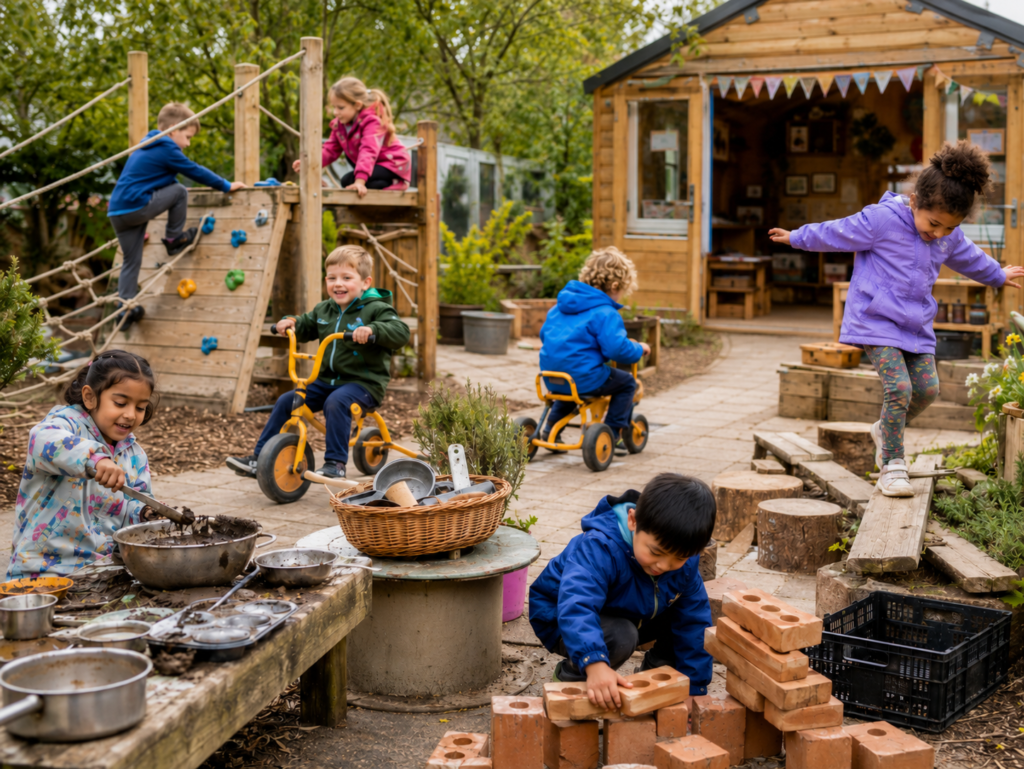
A child can spend an entire outdoor session sitting at a table, standing at a mud kitchen or becoming absorbed in small-world play. These may all be valuable experiences, but outdoor access alone does not guarantee movement.
As a general principle, outdoor learning should be bigger, louder and more physical. It should offer experiences for which there is insufficient space indoors.
Outdoor provision needs:
- sufficient space for energetic movement;
- resources children can lift, carry, transport and combine;
- climbing, balancing and jumping challenges;
- opportunities for ball play, chasing and dancing;
- large-scale construction;
- uneven surfaces and changes of level, where possible;
- adults who notice who is moving and who is not.
We also need to consider who controls the most physically active spaces.
Which children dominate the bikes and scooters?
Who always reaches the climbing equipment first?
Who watches from the edge?
Who avoids movement because they lack confidence, cannot access the equipment, find the space overwhelming or find physical activity challenging?
Simply making equipment available is not enough. Adults need to observe patterns of participation and sensitively support children who are excluded, hesitant or overlooked.
Moderate-to-vigorous activity will not happen by accident
For children aged three and four, at least 60 minutes of the daily total should involve moderate-to-vigorous physical activity.
That means movement which raises the child’s level of exertion. In practice, we might notice:
- faster breathing;
- increased warmth;
- flushed cheeks;
- sustained energetic movement;
- brief pauses before returning to play;
- a child removing a jumper;
- a child asking for a drink.
A useful question to ask is:
When do these children first have an opportunity to get out of breath?
In many schools I work with, a small adjustment to the timetable—allowing time for daily physical movement before phonics—has had a positive impact on children’s regulation and readiness to focus, while also increasing their daily movement.
By ensuring that children have genuine opportunities to run, chase, climb, dance and jump with sufficient energy and duration, we can make a significant difference to their physical and mental wellbeing.
A short walk from the carpet to the table is movement, but it is not moderate-to-vigorous activity. A screen-based “movement break” completed in front of the whiteboard is also unlikely to get most children out of breath.
We have to be honest about the distinction.
Movement carries the curriculum
I sometimes hear people talk about movement as though it takes children away from the “real learning”. Practitioners know that children need to move more, but they also have a succession of planned activities to complete and feel under pressure to fit everything in.
When we change our mindset and recognise that movement can support language, mathematics, literacy, executive function, personal development and social learning, we begin to see the possibilities.
Recently, I observed a mathematics lesson in a Reception classroom. The children were learning about eight. The lesson focused on identifying groups of “eight” and “not eight”, and the teacher had followed the lesson plan to the letter.
The children looked at groups of objects on the whiteboard and decided whether each group represented eight or not eight.
Unfortunately, they had already sat through a 40-minute literacy lesson and a 40-minute phonics lesson. Unsurprisingly, at age 4 and 5, they were restless and struggled to focus.
The same objective could have been explored outside. The children could have thrown beanbags into a hoop and decided whether there were eight or not eight. They could have moved into groups of eight, created groups that were not eight, or collected sets of eight objects from around the environment.
One small change can make a huge difference. The same learning objective is achieved, but in the process children are able to move and that means that they’re not focussing on keeping their bodies still.
Children can retell stories through gesture, drama and movement. They can describe speed, direction, position and force. They can count jumps, compare distances and create repeating movement patterns. They can build large structures, predict whether they will remain stable and test their theories.
During physical play, children follow instructions, remember sequences, negotiate rules and solve problems. They inhibit actions, wait, stop, start and change direction. They develop social skills, language and executive function. They plan routes, retrieve resources and adapt what they are doing when something does not work.
Consider the executive function involved in a chasing game. The child must hold the rules in mind, monitor the movements of others, control the impulse to start too soon, change direction, manage excitement and respond flexibly as the game changes.
That is not a break from learning. That is deep learning for a young child.
Movement, embodied cognition and literacy
The relationship between movement and learning is explored particularly helpfully by Hetty Roessingh and Michelle Bence in their work on embodied cognition.
Embodied cognition challenges the idea that thinking happens only in the brain, disconnected from the body. Children build knowledge through sensory and physical interaction with people, objects, materials and spaces.
Roessingh and Bence (2018) argue that sensorimotor, cognitive and linguistic development work together. Direct physical experiences provide children with information that can be mapped onto language, helping them to construct increasingly complex mental representations.
Their framework places children at the centre, interacting with real objects and materials in real time through purposeful, play-based experiences. This has significant implications for early literacy. Handling blocks, clay, puzzles, paper, crayons, scissors and construction materials develops more than isolated fine-motor control. These experiences bring together touch, perception, movement, planning, language and thought.
Roessingh and Bence argue that these body–mind–brain connections contribute to the foundations needed for drawing, printing, spelling and written composition.
Of course, this does not mean that running automatically teaches reading or that climbing is a substitute for systematic phonics. It means that literacy development rests upon wider foundations than letter recognition and sound recall.
Children need language, meaning, memory, attention, physical control, spatial awareness, confidence and something worth communicating.
Songs, rhymes and finger plays combine language, rhythm, gesture and movement. Acting out stories helps children internalise sequence, character, action and narrative structure. Large-scale mark-making allows children to use their shoulders, arms and whole bodies before being expected to produce controlled movements within a small space. Learning is not a disembodied act.
Babies need freedom to move too
For babies, the guidance recommends physical activity several times each day. Babies who are not yet mobile should accumulate at least 30 minutes of tummy time while awake, spread across the day.
Baby rooms therefore need clean, comfortable and interesting floor spaces where babies can:
- reach and grasp;
- turn their heads and bodies;
- push through their arms;
- roll and pivot;
- pull themselves forwards;
- crawl and cruise.
Babies need adults nearby, talking, responding and offering reassurance, but they also need freedom from equipment that restricts movement.
Highchairs, reclining seats, bouncers and pushchairs may all serve a purpose, but we should review how much of a baby’s waking day is spent contained rather than moving freely.
Inclusion matters
The guidance acknowledges that the evidence base for disabled children under five remains limited, while also recognising that children with medical conditions or disabilities are likely to benefit from increased physical activity.
Our response must not be to remove physical challenge. Nor should we expect every child to complete the same movement, in the same way, at the same speed. Inclusive physical provision starts with the child’s strengths, needs and functional starting point. It may involve:
- adapting equipment;
- providing additional space or time;
- reducing sensory demands;
- offering physical support;
- breaking an action into smaller steps;
- using visual cues;
- seeking specialist advice;
- finding alternative ways for the child to participate.
Inclusion means adapting movement, not removing it.
So, what now for schools and settings?
Rather than producing another checklist or asking staff to record every minute of activity, I would begin by observing the lived experiences of a small number of children.
Ask:
- When are they moving?
- At what intensity?
- How long do they spend waiting or sitting?
- Which children dominate the active spaces?
- Which children remain on the edge?
- Does the environment offer progression and challenge?
- Do routines interrupt play unnecessarily?
- Are indoor and outdoor spaces equally accessible?
- Are children developing a broad range of movements, or repeating the same few experiences?
- What do adults do when a child rarely chooses energetic play?
Look beyond what is available and notice what children actually experience.
A climbing frame listed on an inventory tells us nothing about who uses it, how frequently it is used, whether it provides sufficient challenge or whether children with additional needs can access it.
Movement is an entitlement, not an optional extra
It is vital that we remember that physical development is a prime area of learning within the statutory EYFS. It would be helpful if greater emphasis were placed on this by external advisers and those who evaluate early years practice.
Implemented well, this guidance should contribute to children who have:
- stronger bodies and greater physical confidence;
- better balance, coordination and spatial awareness;
- more experience of judging manageable risk;
- richer opportunities for cooperation, negotiation and friendship;
- improved sleep and general wellbeing;
- greater capacity to regulate energy and attention;
- more opportunities to develop language and thinking through embodied experience.
But achieving this requires us to question routines, timetables and expectations.
It requires us to reconsider how long children sit and how much freedom and autonomy they have to use their whole bodies.
It requires us to recognise that movement is not a distraction from learning, it is one of the ways in which young children build the knowledge, language, physical control and mental representations upon which later learning depends.
Early years classrooms should not be places in which children occasionally move. They should be places designed around the fact that young children learn, develop and remain healthy through movement.
References
Department for Education (2026) Early years foundation stage statutory framework for group and school-based providers. London: Department for Education.
Department of Health and Social Care (2026) UK Chief Medical Officers’ physical activity guidelines. London: Department of Health and Social Care.
Johnson, S.R. (2014) Teaching our children to write, read and spell: A developmental approach looking at the relationship of children’s foundational neurological pathways to their higher capacities for learning. Originally published 2007; revised 3 February 2014. You and Your Child’s Health.
McCarthy, C. (2023) ‘Play helps children practice key skills and build their strengths’, Harvard Health Publishing, 7 June. Updated 20 April 2026.
Neaum, S. (2021) What Comes Before Phonics? 2nd edn. London: SAGE Publications.
Ofsted (2024) Strong foundations in the first years of school. Manchester: Ofsted.
Pagani, L.S. and Messier, S. (2012) ‘Links between motor skills and indicators of school readiness at kindergarten entry in urban disadvantaged children’, Journal of Educational and Developmental Psychology, 2(1), pp. 95–107. doi: 10.5539/jedp.v2n1p95.
Roessingh, H. and Bence, M. (2018) ‘Embodied cognition: Laying the foundation for early language and literacy learning’, Language and Literacy, 20(4), pp. 23–39. doi: 10.20360/langandlit29435.
Leave a Reply