Following Through on Follow Through
When research becomes a teaching prescription
A little while ago, I wrote a blog about Project Follow Through, the enormous American educational experiment that is frequently held up as proof that Direct Instruction is the most effective way to teach children. I think you’ll find it’s a bit more complicated than that… – Ruth Swailes
Since then, I’ve been chatting to several professionals about the blog and the Project Follow Through findings, and the more we’ve talked, the more interesting things have become. Thanks to Paul Hopkins, who sent me the link, I’ve been looking at the original 1977 evaluation by Stebbins and colleagues. It’s almost 300 pages long, so probably not everyone’s idea of a relaxing weekend read, but there are some fascinating findings buried in there. Findings that don’t always seem to make it into the conversations we have about Project Follow Through today.
Now, before anyone gets excited, I’m not about to suggest that Direct Instruction doesn’t work. Of course it does. There are times when explicit teaching is exactly what children need. I’m a teacher. I’ve taught children from Nursery to Year 6, and I’ve seen the difference that clear explanations, modelling, demonstration and carefully planned teaching can make.
But I’ve also seen what happens when we take a particular approach to teaching, remove it from the context in which it was developed, and decide that it must therefore be the best way to teach everything, and I think that’s where we need to be a little more careful.
What did the researchers actually find?
One of the things that really struck me when reading the original evaluation was just how much variation there was between different settings.
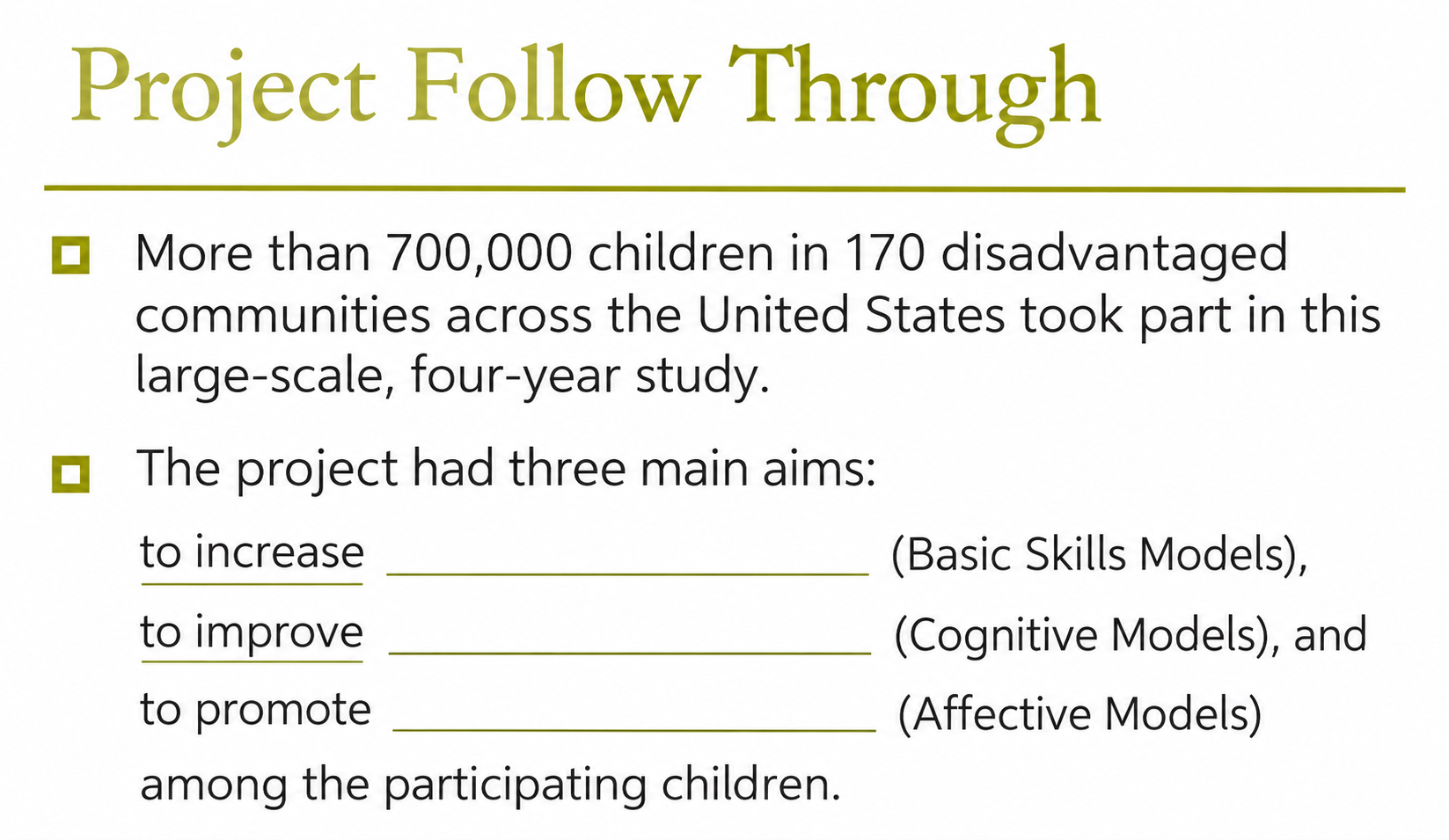
The researchers compared a range of educational approaches, implemented in different communities across the United States. Some focused primarily on basic skills, others on cognitive development, problem-solving, children’s attitudes towards learning and other aspects of development. Direct Instruction performed particularly well on measures of basic skills. That’s an important finding, and one we shouldn’t dismiss.
But here’s the interesting bit.
The researchers also found that the effectiveness of individual approaches varied considerably from one setting to another.
In fact, they stated:
“No model has shown itself to be powerful enough to raise test scores everywhere it has been tried.”
Even the most successful models had settings where the results were disappointing. Equally, some of the less successful models produced positive outcomes in particular communities.
The researchers recognised that the circumstances in which a programme was implemented mattered. If you’ve ever been on any of my training, you’ve probably heard me talk about Bronfenbrenner, so this really resonated with me!
To me, that conclusion sounds rather different from the idea that Project Follow Through identified one universally superior way of teaching?
Because if the same approach produces different outcomes in different settings, surely we need to ask why. What was happening in those classrooms? Who were the children? What did the adults understand about the approach? How was it implemented? What were the relationships like? What other experiences were children having?
The evaluation doesn’t provide us with all those answers, but it certainly suggests that context matters. That’s something we should never lose sight of when we’re talking about teaching young children.
What were they actually measuring?
This is another area where I think we need to be really careful.
Project Follow Through is often discussed as though the researchers were measuring the overall quality of children’s education. They weren’t.
They were measuring particular outcomes using particular assessments.
The basic skills measures included vocabulary, arithmetic computation, spelling and language. Other assessments explored aspects of cognitive development, problem-solving, self-esteem and attitudes towards achievement. These are important things to measure, but they’re not the whole of education.
Think about what we value in early childhood. We want children to become confident communicators, curious thinkers, imaginative players and increasingly independent learners. We want them to develop relationships, learn to manage their emotions, solve problems, negotiate, collaborate, move confidently and develop a sense of themselves as capable people.
We want them to develop knowledge and skills, of course we do, but we also want them to become children who are interested in the world around them and motivated to learn more.
Some of these things can be measured relatively easily. Others are much more difficult to capture through standardised assessments.
Here’s something particularly interesting.
The original researchers themselves acknowledged that the assessments might not adequately capture the progress children were making through approaches that placed less emphasis on basic skills. They couldn’t establish whether weaker basic-skills results reflected less effective teaching of those skills or whether the assessments failed to recognise other progress children had made.
That’s quite an important admission.
It doesn’t mean those other approaches were necessarily better than the results suggested. We simply don’t know. But it does mean that we should be cautious about drawing conclusions that go beyond what was actually measured.
When we judge the effectiveness of an educational approach, we need to ask not only what the results tell us, but also what they don’t tell us.
So did Direct Instruction “win”?
Well, that depends on what you mean by “winning”.
If we’re asking which approaches were most successful at improving children’s performance on the basic-skills assessments used in the evaluation, then Direct Instruction performed particularly well. That’s what the evidence tells us.
But if we’re asking which approach provided the richest, most appropriate or most effective overall educational experience for young children, that’s a rather different question.
And it’s not one that Project Follow Through can answer definitively. This is where I think the way we talk about research becomes problematic.
We take a complex study, involving different children, different communities, different educational approaches and different measures of success, and reduce it to a league table.
One approach “wins”. The others “lose”.
And before long, the findings are being used to justify how teachers should teach children in classrooms thousands of miles away, half a century later. I’m not sure that’s a particularly sensible way to use research.
It also creates an unnecessary divide between approaches that are not necessarily mutually exclusive.
Direct Instruction is often presented as the opposite of play-based learning, as though teachers must choose between teaching children and allowing them to play.
But that’s a false choice. Effective early years practitioners teach all the time. Due to the nature of my work, I’ve visited thousands of classrooms in schools all over the world. I’ve spent time in more early years classrooms than I can count, and I’ve never visited a classroom where teachers aren’t teaching.
They teach through conversations, demonstrations, explanations, modelling, shared experiences, carefully planned environments and sensitive interactions. Sometimes they gather children together and teach something explicitly. Sometimes they work alongside a child who is deeply involved in their play. Sometimes they introduce a new idea or demonstrate a skill. Sometimes they recognise that the most helpful thing they can do is step back.
The important question isn’t whether teaching is direct or indirect. It’s whether the teaching is appropriate for what the child is learning, what they already know and understand, and what they need next.
In my previous blog I referenced both the EPPE and REPEY Studies, both of which identified that a balanced pedagogical approach was most effective when working with young children.
What about children’s confidence and self-esteem?
There’s another finding from the original evaluation that I think deserves attention.
The researchers found that models emphasising basic skills generally performed at least as well as other approaches on the measures of self-concept used in the study. That’s interesting because it challenges the assumption that more structured approaches to teaching necessarily have a negative impact on children’s confidence or attitudes towards learning.
We shouldn’t ignore that finding simply because it doesn’t fit comfortably with our own views about pedagogy. But we also need to recognise the limitations of what was measured.
Self-esteem and achievement responsibility are not the same as the full range of personal, social and emotional development that we understand to be so important in early childhood.
They don’t tell us everything about children’s relationships, emotional security, agency, wellbeing or sense of belonging and they certainly don’t tell us everything about the quality of children’s day-to-day experiences.
Again, it’s about understanding what the evidence can reasonably tell us.
What happened to the gains?
Something else that caught my attention was the discussion about the extent to which children maintained their progress over time. The researchers found that many of the relative gains in arithmetic computation occurred during the first two years of participation.
During the following two years, many groups either maintained their relative position or lost ground compared with children outside the programme. Some Direct Instruction groups were exceptions.
The report also found that sustained relative gains in reading were not evident in the longitudinal analysis described. Now, I’m not suggesting that early gains don’t matter. Of course they do. But it raises another important question.
Are we interested in what children can demonstrate immediately after being taught something, or are we interested in what they understand, remember and can use over time?
Ideally, I’d say we need to be interested in both.
We need to consider whether children can apply what they’ve learned in different situations, make connections, solve problems and build upon their knowledge.
This is particularly important in early childhood, when so much learning is interconnected.
A child might learn to count objects accurately during an adult-led activity, but can they use that understanding when sharing resources with a friend, building a tower, setting the table or working out how many more blocks they need?
A child might learn a particular vocabulary item during a teaching session, but do they understand it well enough to use it meaningfully in conversation and play?
Teaching something and securing meaningful learning are not necessarily the same thing. That distinction matters.
Following the evidence, or following the headlines?
We’re frequently told that education should be evidence-informed.
I couldn’t agree more.
But being evidence-informed means understanding the evidence, not simply repeating someone else’s interpretation of it.
It means looking at what researchers were trying to find out, who participated, what was measured, how the research was conducted and what limitations were identified.
It also means recognising that research rarely provides us with straightforward instructions about what to do with every child in every classroom. That’s not a weakness of research. It’s a reflection of the complexity of education. It’s why professional knowledge and judgement matter so much. Research will only get us so far! I worry when research is presented to teachers as though it removes the need for them to think critically about their practice.
We see this in all sorts of ways. A particular approach is identified as effective, and before long it’s being promoted as something that everyone should be doing.
Sometimes the original findings become simplified. Sometimes important qualifications disappear. Sometimes approaches are applied to children or contexts that weren’t included in the original research. Sometimes we end up doing things because we’ve been told they’re evidence-based, without really understanding what the evidence says.
That’s not evidence-informed practice. That’s blindly following instructions. There is a difference.
What does this mean for early years?
For me, the most important lesson from Project Follow Through isn’t that one approach “won” and another “lost”.
It’s that teaching and learning are complex, and we need to be careful about making universal claims from research conducted in particular circumstances.
Young children need knowledgeable, skilled adults who understand child development, curriculum and pedagogy. They need adults who know when to explain, demonstrate, model, question, comment, challenge, support and step back. They need opportunities to practise and consolidate what they’ve learned, but they also need time to explore, experiment, investigate, imagine, move, talk and play.
They need teaching that is intentional, but also responsive. And they need adults who understand that effective teaching doesn’t always look the same. Sometimes the most appropriate response is direct explanation. Sometimes it’s a carefully chosen resource. Sometimes it’s joining a child’s play and introducing a new idea. Sometimes it’s recognising that the child is already thinking deeply and doesn’t need us to interrupt.
None of these approaches should be dismissed simply because they don’t fit neatly into a particular teaching model. The skill lies in knowing what to do, when to do it and why. This is why working with young children is perhaps more complex than many who have limited experience in the field realise.
Perhaps we’re asking the wrong question
Almost fifty years after the Stebbins evaluation, Project Follow Through is still being used to support arguments about how children should be taught. I think that’s worth reflecting on.
Not because research becomes irrelevant as it gets older. Good research can remain valuable for decades. But because our understanding of child development, learning, language, relationships, executive function and the role of play has continued to develop.
We have a much broader body of evidence available to us now. So perhaps instead of asking which approach “won” Project Follow Through, we should be asking what the research can contribute to our understanding of effective teaching, alongside everything else we now know.
Perhaps we should also be asking why we seem so determined to find one approach that works for everyone. Children aren’t all the same, their experiences aren’t all the same, their developmental pathways aren’t all the same and their learning needs aren’t all the same.
Why, then, would we expect effective teaching to look exactly the same for every child, in every classroom, in every school?
Of course we should learn from research. Of course we should use approaches that have been shown to be effective. But we also need to understand the limitations of that evidence, consider the context in which we’re working and draw upon our professional knowledge of the children in front of us.
Evidence should inform our professional judgement, not replace it.
And perhaps that’s the most important thing we can learn by following through on Follow Through.
References
Siraj-Blatchford, I., Sylva, K., Muttock, S., Gilden, R. and Bell, D. (2002) Researching Effective Pedagogy in the Early Years. London: Department for Education and Skills
Stebbins, L. B., St. Pierre, R. G., Proper, E. C., Anderson, R. B. and Cerva, T. R. (1977) Education as Experimentation: A Planned Variation Model. Volume IV-A: An Evaluation of Follow Through. Cambridge, MA: Abt Associates Inc. Prepared for the U.S. Office of Education.
Sylva, K., Melhuish, E., Sammons, P., Siraj-Blatchford, I. and Taggart, B. (2004) The Effective Provision of Pre-School Education (EPPE) Project: Final Report: A Longitudinal Study Funded by the DfES 1997–2004. London: Institute of Education, University of London/DfES/Sure Start.
Leave a Reply